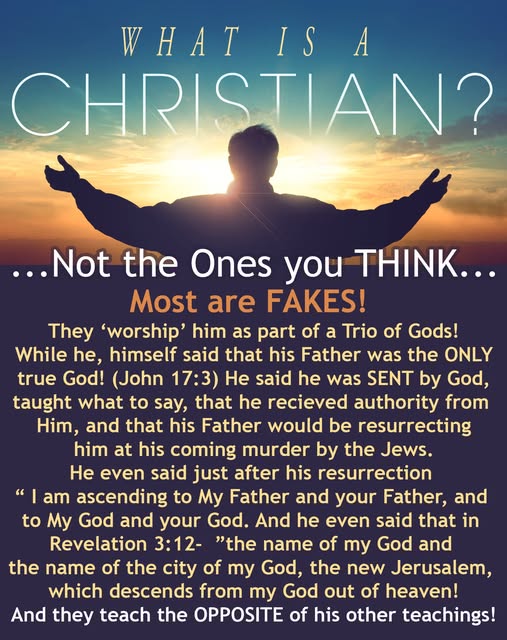
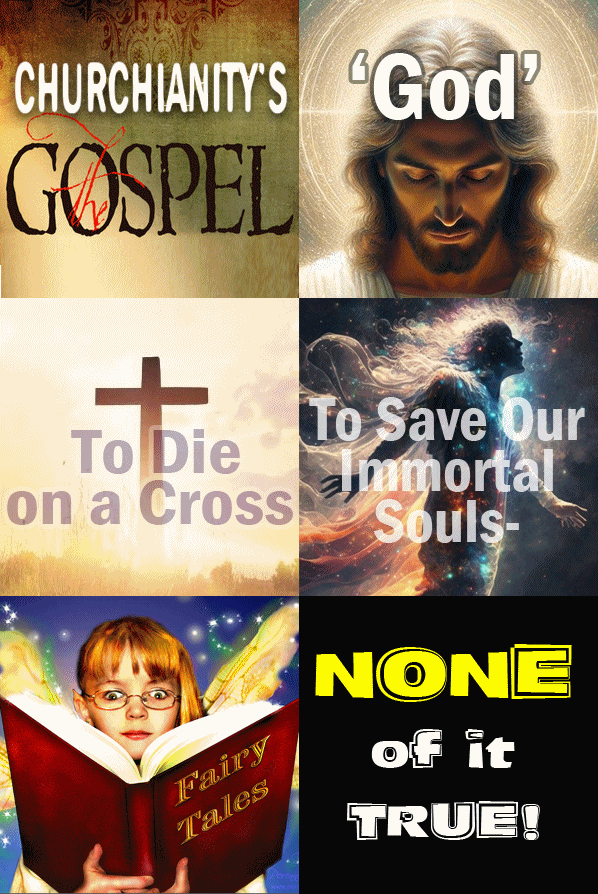
Isn't a "Christian" supposed to believe what Christ has SAID?

Comments
-
How many definitions does "ONLY" have?
-
-
-
What is Truth ?
How can the New World Translation of John 1:1 "In the beginning was the Word, and the Word was with God, and the Word was a god." be truthfully consistent with scripture ? (contradicts Isaiah 44:6-9 as there is NO god beside יהוה Yahweh, the king of Israel, and its redeemer, יהוה Yahweh of hosts).
Question: did τὸν θεόν The Most High God make a mistake in this spoken command to followers of יֵשׁוּעַ Jesus:
πιστεύετε εἰς τὸν θεόν, καὶ εἰς ἐμὲ πιστεύετε (John 14:1 Greek spoken by יֵשׁוּעַ ) ?
Be Ye Believing in The אלהים God, also in Me Be Ye Believing
Why did τὸν θεόν The Most High God command followers (Ye is the archaic English plural of You) of יֵשׁוּעַ Jesus to continously Be Believing in יֵשׁוּעַ Jesus the same as continously Be Believing in τὸν θεόν The Most High God ?
What is the most important command in the Law (Books of Moses) ?
Luke 10:25-28 New World Translation:
25 Now look! a man versed in the Law stood up to test him and said: “Teacher, what do I need to do to inherit everlasting life?” 26 He said to him: “What is written in the Law? How do you read?”
27 In answer he said: “‘You must love Jehovah your God with your whole heart and with your whole soul and with your whole strength and with your whole mind’e and ‘your neighbor as yourself.’”
28 He said to him: “You answered correctly; keep doing this and you will get life.”
Deuteronomy 6:4-5 New World Translation:
4 “Listen, O Israel: Jehovah our God is one Jehovah. 5 You must love Jehovah your God with all your heart and all your soul and all your strength.
Truthfully "Jehovah" disrepects Jewish disguise for pronouncing יהוה outside of the Holy Temple, the place of prayer for ALL nations.
My experience with Holy יהוה Lord אלהים God is consistent Truth (does not change over time, vastly different than a variety of human Watchtower Society doctrines).
JeHoVaH & YeHoWaH show JHVH & YHWH (transliterations of יהוה) with Jewish Masoretic vowel markings added centuries after the destruction of the Jewish Temple in Jerusalem. Jewish oral law was written down into the Mishnah and Talmud (predates Masoretic vowel marking additions), which document the Holy יהוה divine name being pronounced correctly by Jewish priests in the Jewish Temple, but a disguise (or an epithet, a substitute: e.g. Adonai, Lord, HaShem, The Name) used outside the Jewish Temple. Masoretic scripture disguise: write יהוה letters in the correct order from right to left while adding vowels points in the reverse direction => Jehovah or Iehouah that appeared less than 500 years ago by Tyndale.
Ancient Hebrew הַלְלוּ־יָהּ "Praise Yah" = HalleluYah = Hallelujah provides "a" vowel sound evidence against Jehovah vocalization whose first vowel sound is "e". The non-existence of Hallelujeh also testifies against Jehovah vocalization.
Ancient Hebrew הַלְלוּ־יָהּ "Praise Yah" = HalleluYah = HalleluJah to Greek ἁλληλουϊά translation also has "a" vowel sound evidence against Jehovah vocalization whose first vowel sound is "e". The non-existence of Greek Hallelujeh translations in the New Testament and Early Christian Literature likewise testifies against Jehovah vocalization.
Additionally Ancient Hebrew names ending with the first three letters (ya-hu) of יהוה testify against Jehovah vocalization. Jewish Rabbi IBN EZRA described how to discern the correct יהוה vocalization (same way יהוה Ruach HaKodesh guided me):
One who is educated in Hebrew grammar can intuit the pronunciation of the Name from such forms of it as “Ehyeh” and “Yah”; even the name of Elijah the prophet will teach one rightly. But this is all secret.
Michael Carasik, ed., Exodus: Introduction and Commentary, trans. Michael Carasik, First edition., The Commentators’ Bible (Philadelphia, PA: The Jewish Publication Society, 2005), 21.
Likewise blasphemy trial procedures in the Mishnah (~200 CE), Jerusalem Talmud (~400 CE), and Babylonian Talmud (~500 to 600 CE) have vowel a-o-e sounds in a verbal substitute for יהוה ("May Yose smite Yose") while Jehovah has the reversed vowel e-o-a sounds order.
Deuteronomy 6:4 שמע ישראל יהוה אלהינו יהוה אחד
sh'-MA yis-ra’-AYL a-do-NAI e-lo-HAY-nu a-do-NAI e-KHAD
['Hear & Obey' Isra’el! Adonai 'Plural God of We' Adonai unique]
שמע : sh'-MA : Hear & Obey - verb, Qal, imperative, 2nd person, singular
ישראל : yis-ra-AYL : Israel - noun, proper, singular, absolute
Imperative (command) verb Hear & Obey qualifier: Israel
יהוה : a-do-NAI : Lord - noun, proper, masculine, singular, absolute (a-do-NAI is Jewish disguise outside of the Jewish Temple for reading Holy Scripture: Hebrew Bible Text has 299 verses where a-do-NAI is qualified by יהוה )
אלהינו : e-lo-HAY-nu : אלהים God (plural) of we - noun, common, masculine, plural, construct (of) & pronoun, suffixed, 1st person, plural
יהוה qualifier: God (plural) of We (plural)
English alternative wording for "of We" is Our. To me, "of We" shows יהוה quality eternally having three (plural) simultaneous voices
יהוה : a-do-NAI : Lord - noun, proper, masculine, singular, absolute (a-do-NAI is Jewish disguise outside of the Jewish Temple for reading Holy Scripture: Hebrew Bible Text has 299 verses where a-do-NAI is qualified by יהוה )
אחד : e-KHAD : alone, unique, one, only - numeral, cardinal, singular, absolute
יהוה qualifier: Unique, One, Only, Alone
To me, אחד quality shows יהוה being the ONLY GOD to worship, who has three (plural) simultaneous voices: Abba (Father), Yeshua (Son), Ruach HaKodesh (Breath The Holy)
Keep Smiling 😊
-
truth is truth
-
Speaking to this thread’s original question, “Isn’t a “Christian” supposed to believe what Christ has said?”, the straightforward answer clearly is yes. And it is certain that all “Christians” everywhere will hold to the belief that they believe all that Christ has said. However, there will, at times, be differences between these “Christians” in their interpretation and application of “what Christ has said”.
Without question it is the case that orthodox “Christian” monotheism believes there is numerically only one true God worthy of worship and service. Although, differences arise as to whether this one true God is, in His essential Being, uni-personal or tri-personal.
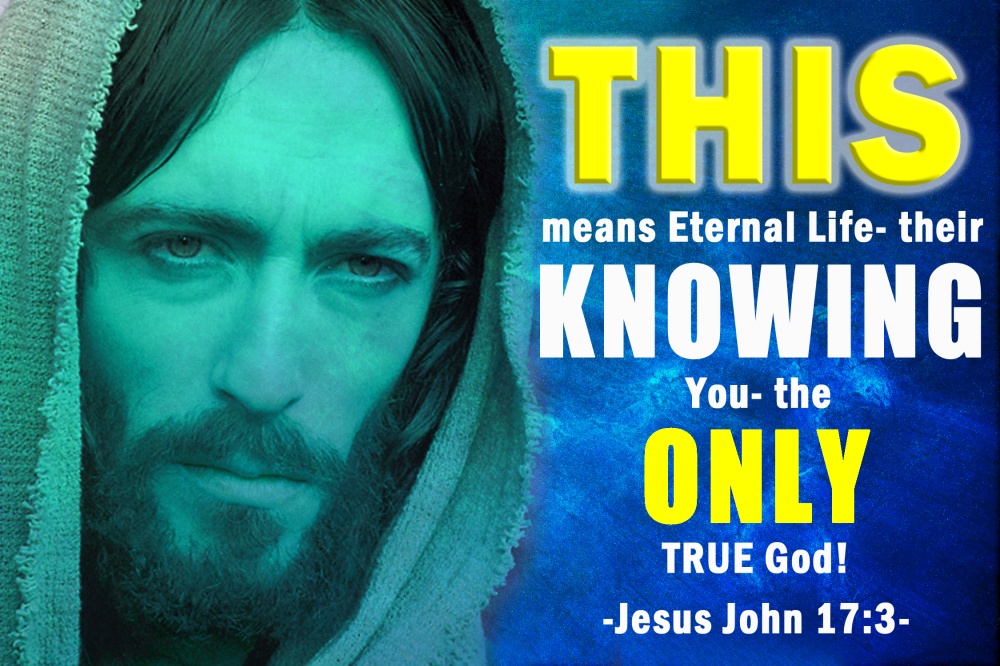
And, in bringing up the text of Jn. 17:3 you wish to point out the apparent confirmation for the uni-personal view the Watchtower and yourself believe—the Father alone is true God.
This position as expressed in your question fails to understand that all “Christians” can, and will, affirm that the Father is the only true God.
From the trinitarian perspective our disagreement lays with your view that the Person of the Father alone is the only true God to the exclusion of the Son and the Holy Spirit.
That God in His Being is One does not necessarily mean a oneness in Person. There is a subtle difference to be made grammatically between stating “you alone, the true God”—which is what the Watchtower and yourself subconsciously read into this text—and the statement “you, the only true God, and Jesus Christ”. The adjective “only” directly modifies God, not the pronoun “you”.
A quick note here, the Father is eternal and to be eternally the Father there must be an eternal Son—God’s essential nature is eternally unchangeable—therefore, the Son can not have come into existence at some point, since the Father has eternally been the Father. Moreover, if the Father is true God, then it follows that the Son must also be true God having the same nature as his Father (Jn. 1:1).
At this point I specifically want to address the portion of text in Jn. 17:3 left out in your initial post—“and Jesus Christ, whom you have sent.”.
- “Now this is eternal life: that they know you, the only true God, and Jesus Christ, whom you have sent.” (Jn. 17:3)
That “and” grammatically binds the Father and the Son together as defining “eternal life”—eternal life consists of knowing Father and Son. It is through the relational knowing of both the Father and His Son, Jesus Christ, that eternal life is obtained—both “you” and “Jesus Christ” are objects of the verb “know” (cf. 1Jn. 1:2).
And, to know the Father, it is now exclusively through His Son who makes his Father known (Jn. 1:18; 14:6-7) to those whom he chooses to reveal Him (Mt. 11:27; Lk. 10:22) (cf. Jn. 8:19).
When speaking of eternal life it is worth noting that the NT attributes this economy to the Son (Jn. 10:28, 17:2; 1Jn. 1:2; Ro. 5:21, 6:23; Jn. 3:15, 16, 36, 6:40; 1Tim. 1:16; Jn. 1:12, 20:31; 1Jn. 5:13; Acts 4:12).
Scripture will go on to say that eternal life comes also from the Spirit (Gal. 6:8). And, that the Father has given eternal life, it is His will, and this life is in His Son (1Jn. 5:11-12; Jn. 6:40, 1:4, 11:25).
One cannot help but recognize that eternal life can only come from that which is itself by nature eternal, and the operational participation in this economy by each of the three distinct Persons—the Father, the Son, and the Holy Spirit.
Importantly, in trinitarian belief the Father and the Son and the Holy Spirit are distinct Persons, not separate Gods—there is numerically only one true God—contra your error of “a trio of Gods” in your fourth post for this thread.
This trinitarian view is upheld, and explicitly stated, within scripture where the Persons of the Father, and the Son, and the Holy Spirit are subsumed under the one singular divine name Yahweh (Mt. 28:19)—one God, three Persons; three Persons, one God.
One final remark to be made related to Jn. 17:3 will be on the phrase “true God” as it is elsewhere used in John’s writings.
This same phrase is used again in a text that comes with a very well argued case for the grammatical antecedent of the demonstrative pronoun, “This one”, as Jesus Christ—“This one is the true God and eternal life.” (1Jn. 5:20).
Given the grammar of that text it seems most certain this was the understanding which is then exhibited by early creedal statements applying the phrase “true God” to both the Father and His Son, Jesus Christ.
- “And in one Lord Jesus Christ, the only-begotten Son of God, begotten of the Father before all ages; Light of Light, true God of true God, begotten, not created, of one essence with the Father through Whom all things were made.” (emphasis mine)
(Trueman, C. R. (2012). The Creedal Imperative (p. 94). Crossway.).
A couple of items come to mind in summary: that eternal life consists in knowing both the Father and the Son, Jesus Christ, who alone reveals his Father to those whom he chooses. The Father is the only true God in contrast to other gods. And, the Father sent His Son. None of which is in conflict with trinitarian views.
-
In your fourth post you make reference to the texts of Jn. 20:17 and Re. 3:12 calling attention to Jesus’ words “my God” as making the Trinity, so far as you understand it, to be a fairy tail (5th post animation).
What you continually fail to understand about the trinitarian perspective regarding Jesus is the following: “Jesus is fully human, but not merely human. Also fully divine." (T. V. Morris). By that I mean “Jesus is the human presence of the eternal Son, the second person of the trinity" (R. Bauckham). It is the eternal Word who was with God, and was according to his nature God (Jn. 1:1) who became flesh (Jn. 1:14) and is later identified as the man Jesus Christ (Jn. 1:17) who is himself God (Jn. 1:18).
The above does not say that the Son (Word), second Person of the Trinity, is the Father, or the Father is the Son—there is distinction of Person explicit within the text of scripture. Neither does it say the Father and the Son and the Holy Spirit are the very selfsame Person as in modalism. Nor, is it the case that the Father and the Son and the Holy Spirit are separate and independent Gods as in tritheism.
There is no doubt that the eternal Son took on flesh (cf. Ro. 1:3, 8:3; 1John 4:2) by way of a virgin birth (cf. Matt. 1:23; Luke 1:34-35) and in his incarnation (enfleshment) as human flesh (Jesus) he became subject to God and His Law (cf. Jn. 6:38, 8:29).
Scripture states that God is “the God of all flesh” and all flesh is “under the law” (cf. Jer. 32:27; Gal. 4:4)—and therefore, the eternal Son (Word) by taking on flesh and entering into the created order (cf. Jn. 1:14; Phil. 2:7-8; 1Tim. 3:16) will at that very moment begin to relate to his Father as his God.
This new relation continues everlastingly as Jesus, both true man, true God, was raised physically, “flesh and bones” (Lk. 24:39), and ascended to the right hand of his Father.
The use of “my God” by Jesus in these texts (Jn. 20:17; Re. 3:12) is not evidence against the Trinity as the Watchtower wishes to make it. Instead, it demonstrates what scripture explicitly stated regarding human nature (flesh) as it stands in relation to God (Jer. 32:27). The very same nature taken on by the eternal Son (Word) in his incarnation (Jn. 1:14) as the person Jesus who will then, from that point on, relate to his Father as “my God”.